

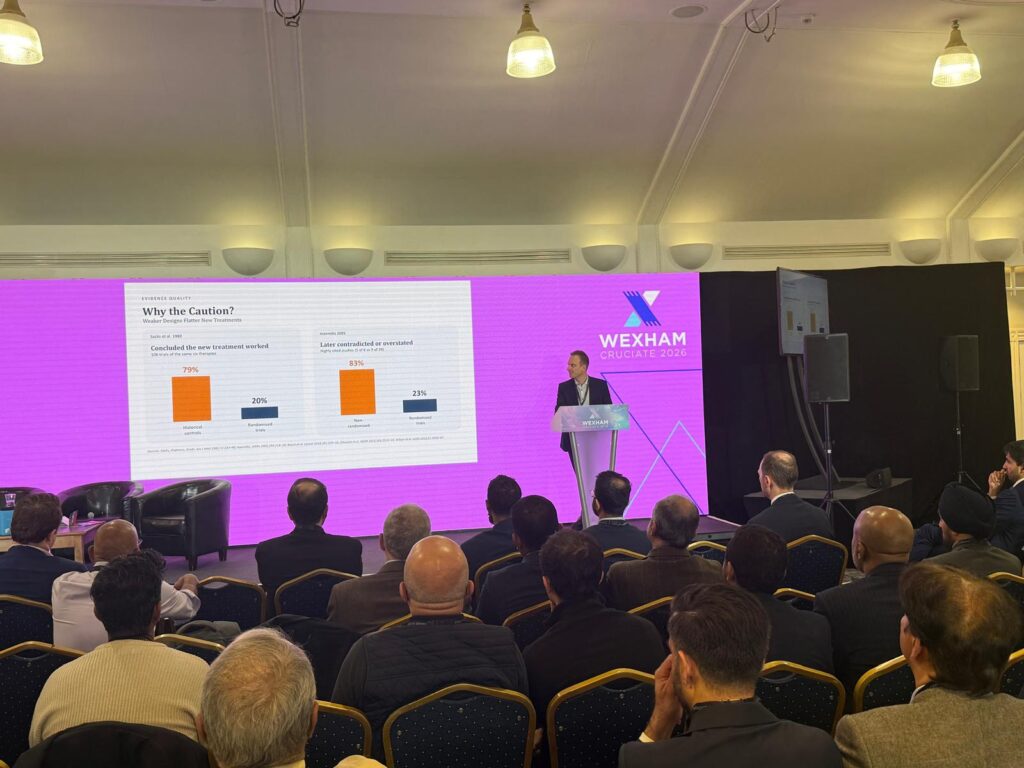
It was a pleasure to be invited to give four talks at the Wexham Cruciate meeting 2026. This meeting has grown and grown, and is now one of the best soft tissue knee meetings around. I have summarised my talks below.
1. Synthetic augmentation in ACL reconstruction: the evidence for and against
Wexham Cruciate Ligament Meeting, November 2026. Nick Smith, Consultant Knee Surgeon, University Hospitals Coventry and Warwickshire; Honorary Associate Professor, University of Warwick; Co-Chief Investigator, STRAP ACL.
ACL reconstruction outcomes are worse than patients are usually told: 28% return to sport at 18 months in the surgical arm of ACL SNNAP, 20–30% residual laxity in STABILITY, and graft rupture of 5–20% in young pivoting athletes. Reinforcing the graft with synthetic tape aims to protect it during ligamentisation. The idea dates to the Kennedy LAD in the 1970s; the synthetic replacements that followed (LARS, Dacron, carbon fibre) failed through fatigue, wear debris and synovitis. Current devices work in different ways, either sutured into and tensioned with the graft (LAD, BioBrace) or independently fixed (InternalBrace), so pooling them hides the signal.
Our meta-analysis with Warwick Clinical Trials Unit (Jiang et al., KSSTA 2025) included 47 studies and 4,289 patients, only 7 randomised. Return to sport improved (OR 1.58, moderate certainty). Graft failure was not significantly reduced across all devices; it was in the InternalBrace subgroup, but on only 218 patients. All 40 non-randomised studies were at moderate or serious risk of bias and no outcome reached high certainty. Non-randomised designs consistently flatter new treatments (Sacks et al. 1982; Ioannidis 2005), as subacromial decompression and degenerative meniscectomy showed.
Regulatory clearance requires safety and equivalence to existing devices, not better patient outcomes. Under the IDEAL framework augmentation sits at stage 2b, while uptake in the USA and UK is rising fast. That is genuine equipoise. STRAP ACL, a £1.9 million NIHR HTA trial, will randomise 318 patients across 20 UK sites to autograft ACL reconstruction with or without independently tensioned tape, with return to sport, graft failure, PROMs, cost-effectiveness and an MRI sub-study as outcomes. Recruitment opens November 2026.
2. Understanding medial and lateral tibial slope anatomy: why the two plateaux are not the same
Wexham Cruciate Ligament Meeting, November 2026. Nick Smith, Consultant Knee Surgeon, University Hospitals Coventry and Warwickshire; Honorary Associate Professor, University of Warwick.
The medial plateau is concave and acts as the stable pivot; the lateral plateau is flat or convex and allows rollback and rotation (Iwaki et al. 2000). ACL injury is rotational and happens laterally, yet most slope measurement and slope-correction decisions use medial slope. Murphy, Ollivier et al. (KSSTA 2026) pooled 24 studies and 6,335 knees: lateral slope was 2.1° higher in graft failures with a significant per-degree risk (aOR 1.15), while medial slope was 1.1° higher and not significant per degree.
Our UHCW cohort of 1,174 ACL reconstructions (2007–2018, minimum 5-year follow-up) found revision and contralateral-injury knees had lower medial and higher lateral slope than primaries, doubling the delta (lateral minus medial) from 3.1° to over 6°. Revision risk rose with lateral slope, but Delta was the strongest predictor. Measurement used a short tibial reference axis, so absolute medial values are not directly comparable with full-length radiograph studies.
With Andrew Amis and the Imperial College team (Nejima et al. 2026) we changed medial and lateral slope independently in 8 cadaveric knees under 500 N axial load. 10° more lateral slope increased anterior tibial translation by 1.7 mm; 10° more medial slope had no significant effect. Opposing combinations, lateral up and medial down, increased internal rotation by up to 13.5° at 20° flexion. Lateral slope drives anterior translation and delta drives rotation, the combined loading pattern that puts most force through the ACL.
In summary, lateral slope is the most important single measure. Medial slope is a reasonable surrogate when the lateral plateau is hard to read. Delta is a powerful risk factor, but for now not an indication for osteotomy on its own.
3. Gold standard multiligament knee injury management
Wexham Cruciate Ligament Meeting, November 2026. Nick Smith, Consultant Knee Surgeon, University Hospitals Coventry and Warwickshire; Honorary Associate Professor, University of Warwick.
A practical pathway for whoever is on call, in a major trauma centre or a district general hospital, from the front door to rehabilitation. Every multiligament knee injury should be treated as a knee dislocation: vascular injury occurs in about 18%, nerve injury, mostly common peroneal, in 25%, and around 2% end in amputation (Medina et al., CORR 2014). Most have reduced before arrival, including low-energy injuries in heavier patients.
In the first hour: reduce and splint, confirm reduction on a lateral X-ray, record a timed neurovascular examination, and get a CT angiogram for every suspected dislocation regardless of pulses, adding the leg to any trauma CT. Hard signs go straight to theatre with the vascular surgeons. A normal CTA still needs 24–48 hours of neurovascular observation, because intimal flaps occlude late. No ligament surgery until a vascular injury is excluded or repaired (BOAST arterial injuries guideline; Murray et al., BJSM 2024).
A hinged brace locked in extension holds most knees. A spanning external fixator is rarely needed and reserved for vascular repair, open injury, a knee that will not stay reduced, obesity or polytrauma, with pins a hand’s breadth clear of the joint and away from future tunnels and graft harvest sites, and off within 4–6 weeks.
Proposed referral thresholds: emergency transfer to the major trauma centre for vascular injury, irreducible, open or fracture-dislocation, and polytrauma; referral to an MLKI knee centre within 48 hours for bicruciate injury, PCL plus collateral, any posterolateral corner injury or peroneal palsy; ACL plus MCL can usually stay with a local knee surgeon. Before transfer, keep the options open: no graft harvest, no tunnels, no isolated ACL reconstruction.
At the MLKI centre: single-stage reconstruction of cruciates and corners within about 3 weeks, repair only for bony or peel-off avulsions, since corner repair alone fails about 3 times as often as reconstruction. Then early motion, because stiffness is the commonest complication.
4. Graft on the floor: ACL reconstruction when it goes wrong
Wexham Cruciate Ligament Meeting, November 2026. Nick Smith, Consultant Knee Surgeon, University Hospitals Coventry and Warwickshire; Honorary Associate Professor, University of Warwick.
A dropped graft is rare but most ligament surgeons will see one. Three messages: have a backup harvest site, consent for an alternative graft source before the day, and if it happens, laboratory evidence supports washing and using the graft.
The graft is not sterile to begin with. 96% of theatre floor swabs and 40% of dropped, unwashed hamstring segments culture positive (Barbier et al., Knee 2015), but so do 23% of hamstring segments taken straight after harvest that never touched the floor (Plante et al., KSSTA 2013). Molina et al. (Arthroscopy 2000) dropped ACL segments on the theatre floor for 15 s: 58% culture positive unwashed, 2% after 90 s in 4% chlorhexidine, 6% after neomycin-polymyxin and 24% after 10% povidone-iodine. In Barbier’s study washed segments had fewer positive cultures than segments that never left the table. Saline alone does not work. Whole tendon soaked in 4% chlorhexidine for 30 min keeps its failure load (Gurbuz 2025), twenty times the exposure needed; surface cells die, which is irrelevant for an autograft that ligamentises.
My protocol: retrieve and strip sutures; soak in 4% chlorhexidine scrub from a fresh sealed bottle for 90 s to 3 min; three saline rinses; vancomycin wrap as routine; re-suture and re-size; record the drop, protocol and reasoning in the operation note and tell the patient the same day; early review with a low threshold to aspirate; normal rehabilitation.
There were no infections in 16 documented washed and reused grafts (Pasque and Geib 2007; Chilean survey 2019), and 59–75% of surgeons who have dropped a graft report washing and reusing it. The one reported sanction I found, an NSW tribunal case involving a chin implant, was for not checking for a replacement, leaving the drop out of the operation note and telling the patient late, not for washing it. Surgeons should check with their own medical defence organisation.
Leave a reply


