STRAP ACL: testing synthetic tape augmentation in ACL reconstruction
Nick Smith, Consultant Knee Surgeon, University Hospitals Coventry and Warwickshire, and Co-Chief Investigator, STRAP ACL.
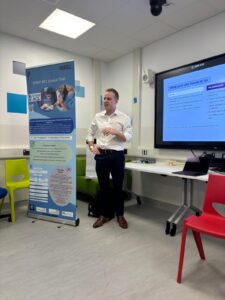
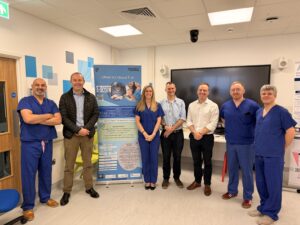
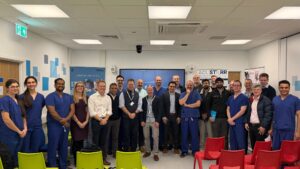
On 25 November, surgeons leading STRAP ACL at hospitals across the UK met in Cambridge at the NIHR Knee Trials Day to get ready for the trial to start. There was a big turnout from our team in Coventry. STRAP ACL is a national research study testing whether adding a strong synthetic tape during ACL reconstruction surgery helps people recover better than the standard operation alone.
STRAP ACL at a glance
| What it tests | Whether adding a synthetic tape during ACL reconstruction gives better results than the standard operation |
| Who can take part | People aged 16 and over who need an ACL reconstruction using a graft taken from their own leg |
| Number of patients | 318 |
| Where | 20 or more NHS hospitals across the UK |
| Main measures | How well people can do everyday and physical activities 18 months after surgery, and whether the tape is good value for the NHS |
| Funding | £1.9 million from the National Institute for Health and Care Research (NIHR172043) |
| Run by | Warwick Clinical Trials Unit, sponsored by the University of Warwick and University Hospitals Coventry and Warwickshire |
| Led by | Nick Smith and Hema Mistry (Co-Chief Investigators) |
| Ethics | Approved June 2026 |
The ACL and ACL reconstruction
The anterior cruciate ligament (ACL) is a strong band of tissue in the middle of the knee. It stops the shin bone sliding forward and the knee giving way when you twist, turn or land. A torn ACL does not heal on its own. ACL reconstruction replaces it with a graft, usually a tendon taken from your own leg: the hamstring, patellar tendon or quadriceps tendon. More than 20,000 of these operations are done in the UK every year.
Why a trial is needed
ACL reconstruction works well for many people, but not as well as most expect. In a large UK study, only 28% of people who had the operation were back to their sport 18 months later, although some other studies have better rates of return to sport. Some grafts stretch or tear again. After surgery the graft takes many months to mature into a new ligament, and during that time it is vulnerable.
Synthetic tape augmentation adds a strong, thin braided tape alongside the graft, fixed separately to the bone. The idea is that it works like a seat belt, protecting the graft while it matures. It is now used in about 1 in 4 ACL reconstructions in the UK.
The research so far is promising but not proven. Our review of the published studies with Warwick Clinical Trials Unit found that people who had the tape were more likely to return to sport, but there was no clear reduction in the graft tearing again. With modern augments, return to sport and re-tearing were both improved, but there were no high quality trials, so confidence in the research is low to moderate.
What happens in the trial
Patients who are eligible are invited by their local hospital team. They agree to take part and fill in some questionnaires before surgery. On the day of the operation, a computer decides at random, like tossing a coin, which group they are in: the standard ACL reconstruction, or the same operation with the tape added. Both operations are already done in NHS hospitals, so taking part does not make treatment riskier.
Patients are not told which group they are in, so that their expectations do not affect the results. The surgeon knows, because they do the operation. Everyone has the same physiotherapy afterwards.
Participants then complete short online questionnaires at 3, 6, 12 and 18 months about how their knee is working, pain, quality of life, return to sport and any problems. At 18 months a member of the team who does not know which group they were in checks the stability of the knee. There are no extra scans: any MRI or X-rays are those taken as part of normal care. We will also ask permission to follow people up for up to 20 years, to see how their knees do in the long term.
Most people aged 16 or over who need an ACL reconstruction can take part. People cannot take part if they need repeat ACL surgery, a donor graft, or surgery on other major knee ligaments at the same time, if they have had a previous bone or cartilage injury in the knee, if they cannot attend physiotherapy, or if they are a professional athlete.
How the tape is used
Surgeons in the trial carry out the rest of the operation in their usual way, including the choice of graft. The tape step is done the same way at every hospital: the tape is fixed to the shin bone with a small anchor, with the knee straight, before the graft is tightened. Only tapes that are fixed separately from the graft are used, such as the InternalBrace and similar products from other manufacturers. Older-style synthetic ligaments that replace the graft are not used.
Why it matters
The tape adds around £400 to the cost of each operation. If STRAP ACL shows that it improves recovery, return to sport or the chance of the graft tearing again, patients and surgeons can choose it with confidence. If it does not, patients avoid an extra implant and the NHS avoids paying for something that does not help. Either way, the answer will change how ACL surgery is done.
The team
STRAP ACL is led by Nick Smith (University Hospitals Coventry and Warwickshire and University of Warwick) and Hema Mistry (Warwick Clinical Trials Unit). The wider team includes Andy Metcalfe, Toby Smith, Nick Parsons, Helen Parsons, Seyran Naghdi and Gulnaz Iqbal (University of Warwick), David Beard (University of Oxford) and Stephen McDonnell (Cambridge). The trial manager is Kerry Raynes. Patients have helped shape the study from the start.
If you are having ACL surgery and would like to know more, ask your surgeon whether your hospital is taking part, email strapacl@warwick.ac.uk, or visit warwick.ac.uk/strapacl.
About the author
Nick Smith is a Consultant Knee Surgeon at University Hospitals Coventry and Warwickshire NHS Trust, where he has led the Soft Tissue Knee service since 2022, and an Honorary Associate Professor at the University of Warwick. He is Co-Chief Investigator of STRAP ACL and co-author of the Warwick review of synthetic augmentation in ACL reconstruction. He speaks regularly on ACL surgery at national and international meetings, including BASK and the Wexham Cruciate meeting. He sees private patients at Nuffield Health Warwickshire Hospital. ORCID: 0000-0003-4628-1496.
References
- Jiang Y, Naghdi S, Smith N, Smith T, Metcalfe A, Mistry H. Synthetic augmentation in anterior cruciate ligament reconstruction: a systematic review and meta-analysis. Knee Surg Sports Traumatol Arthrosc. 2025. doi:10.1002/ksa.12680
- Beard DJ, et al. Rehabilitation versus surgical reconstruction for non-acute anterior cruciate ligament injury (ACL SNNAP): a pragmatic randomised controlled trial. Lancet. 2022.
- STRAP ACL trial page, Warwick Clinical Trials Unit: warwick.ac.uk/strapacl
- HRA research summary, STRAP ACL (IRAS 358746).