

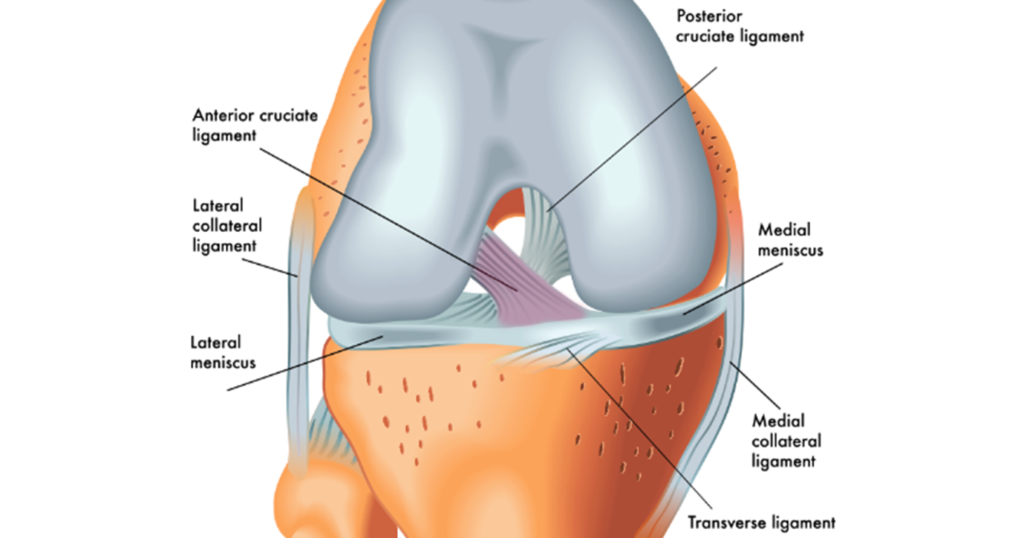
Anterior cruciate ligament (ACL) reconstruction is one of the most commonly performed procedures in sports knee surgery. However, despite advances in surgical techniques and rehabilitation, returning patients safely back to sport — while minimising the risk of graft failure — remains one of the greatest challenges in modern ACL surgery.
Increasingly, surgeons are exploring whether synthetic augmentation, often referred to as “Internal Brace” augmentation, may help protect the graft during the early healing phase and improve return-to-sport outcomes.
What is ACL Augmentation/Internal Brace Surgery?
Augmentation involves reinforcing the ACL graft with a high-strength suture tape construct designed to provide additional stability during graft healing and maturation. Internal Brace refers specifically to Arthrex’s technique of using Fibertape fixed to a button on the femur, and separately tensioned with a Swivelock Anchor in the tibia.
The concept is not to replace the ACL graft itself, but to:
- Protect the graft during the early post-operative phase
- Reduce graft stretching or elongation
- Potentially lower re-rupture rates
- Allow greater confidence during rehabilitation and return to sport
Modern augmentation techniques differ significantly from older synthetic ligament replacements, which historically had poor outcomes due to mechanical failure and synovitis. Contemporary techniques use synthetic reinforcement alongside standard biological grafts rather than replacing them entirely.
Who Uses Them?
The majority of Internal Brace augmentations happen in the USA, but across the rest of the world, their use is increasing rapidly. Latest estimates in the UK are the approximately 15% of all ACL reconstructions are synthetically augmented.
What Does the Current Evidence Show?
Nick Smith recently co-authored a large systematic review and meta-analysis examining whether synthetic augmentation improves outcomes after ACL reconstruction.
The review analysed:
- 47 studies
- 4,289 patients
- Multiple augmentation techniques including Internal Brace augmentation, FiberTape and other synthetic reinforcement systems
The findings suggested that augmentation may improve return-to-sport rates, particularly with modern Internal Brace techniques.
Return to Sport
The meta-analysis demonstrated:
- Higher mid-term return-to-sport rates with augmentation
- Odds ratio (OR) 1.58 for improved return to sport overall
- Internal Brace subgroup OR 2.19 for return to sport improvement
This suggests much better return to sport rates for augmented ACL reconstructions. Several contemporary studies also reported very high return-to-sport rates following Internal Brace augmented ACL reconstruction.
What About Re-Rupture Rates?
One of the most interesting findings from the review was that Internal Brace augmentation appeared to reduce long-term graft re-rupture rates in some studies.
The Internal Brace subgroup demonstrated:
- OR 0.17 for graft failure reduction in long-term follow-up
This also suggests very low failure rates for augmented ACL reconstructions, compared to traditional ACL reconstruction. However, when all augmentation techniques were analysed together, the reduction in graft failure was not statistically significant.
This suggests that:
- Modern augmentation techniques may be more effective than older synthetic systems
- The type of augmentation used likely matters significantly
- We still need much higher-quality evidence before drawing definitive conclusions
The Problem with the Current Evidence
Although the early findings are encouraging, the current evidence base remains limited.
The systematic review concluded that:
- Most studies were low-quality or non-randomised
- Many studies had moderate-to-serious risk of bias
- Surgical techniques varied substantially
- Rehabilitation protocols were inconsistent
- Longer-term outcomes remain uncertain
Importantly, many of the currently available studies are relatively small and may be influenced by surgeon selection bias and evolving surgical techniques.
At present, there is still no definitive answer as to whether Internal Brace augmentation truly improves patient outcomes after ACL reconstruction.
STRAP ACL – A £1.9 Million NIHR Randomised Controlled Trial
To help answer this question properly, Mr Smith is Chief Investigator of the STRAP ACL trial — a major £1.9 million NIHR-funded randomised controlled trial designed to evaluate whether synthetic augmentation improves outcomes following ACL reconstruction.
The study will recruit patients between 2026 and 2028 across multiple centres and aims to provide the highest-quality evidence to date on this increasingly important topic.
The STRAP ACL trial will investigate:
- Return-to-sport outcomes
- ACL graft re-rupture rates
- Patient-reported outcome measures
- Rehabilitation progression
- Imaging and graft healing outcomes
- Safety and complications
The trial has been designed specifically to address many of the limitations identified within the current literature.
The Future of ACL Surgery
Modern ACL surgery continues to evolve rapidly towards increasingly personalised and biomechanically informed treatment strategies.
Potential future developments include:
- AI-driven risk prediction
- Individualised graft and augmentation selection
- Advanced rehabilitation monitoring
- Biological augmentation techniques
- Imaging-based graft maturation assessment
Internal Brace augmentation may ultimately prove to be an important advancement in ACL surgery — particularly for younger, higher-risk athletes — but definitive answers require high-quality randomised research.
The STRAP ACL trial aims to provide that evidence and help guide the future direction of ACL reconstruction surgery across the world.
Leave a reply


Leave a reply